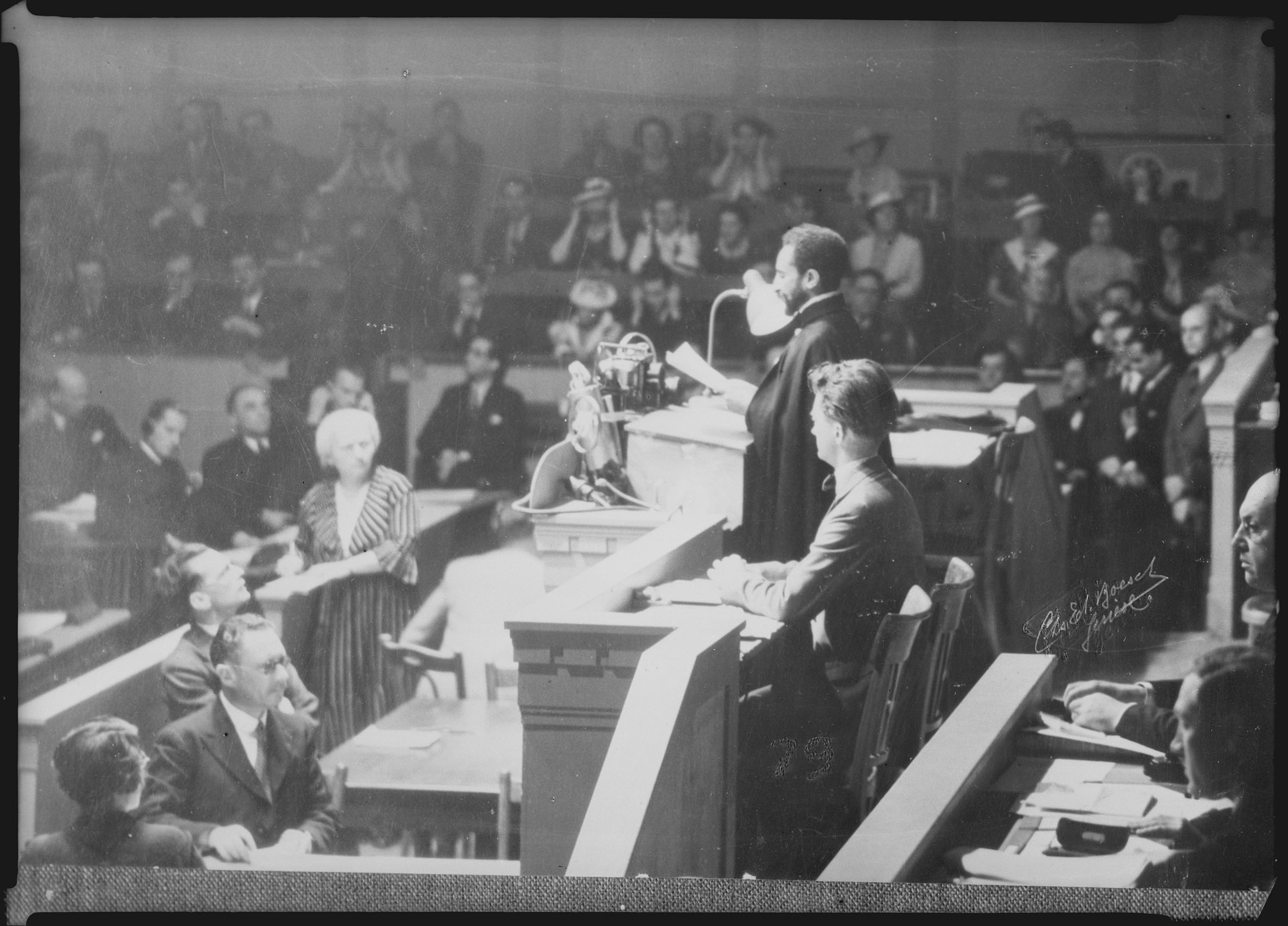
On June 30, 1936, Haile Selassie stood before the League of Nations in Geneva and described what Italy had done to his country. Aircraft had carried poison gas over Ethiopian soldiers and civilians. An independent member of the League had been invaded, its capital occupied and its emperor driven abroad. The institution created to protect international peace had failed its most conspicuous African test.1
For people confronting colonial rule and racial discrimination, Ethiopia’s ordeal reached far beyond the Horn of Africa. Here was a country that had defeated a European invading army at Adwa in 1896, only to discover that recognition as a sovereign state offered little protection when powerful governments found enforcement inconvenient.23
Yet Ethiopia’s international symbolism concealed another struggle. Defending independence did not settle who owned the land, whose language opened government offices, or whether ordinary people could challenge those who ruled them.
An independent country, an unequal empire
In 1918, Ethiopia was governed by Empress Zewditu alongside her regent and designated successor, Ras Tafari Makonnen, the future Haile Selassie. It had escaped European conquest during the partition of Africa, but stood among colonial neighbours. Independence required diplomacy, imported weapons and constant attention to foreign ambitions.2
The country was also an empire in its own right. Under Menelik II, conquest and negotiation had extended its boundaries southward and eastward, incorporating diverse Oromo, Somali, Sidama and other communities. In many conquered districts, land transfers and demands for tribute entrenched inequalities between local cultivators and politically connected beneficiaries. Ethiopia’s survival against European imperialism therefore coexisted with memories of subordination within its borders.4
Those memories remain contested. Some Ethiopians understand nineteenth-century expansion principally as national unification; others describe conquest and internal colonialism. Neither interpretation should erase regional differences, collaboration, resistance or the fact that communities subsequently developed intertwined lives. Nor did all Amhara benefit from the political prominence of Amharic-speaking elites: poor farmers could share a language with rulers without sharing their power.25
Religious life was similarly more diverse than the monarchy’s Christian identity suggested. The Ethiopian Orthodox Church possessed immense cultural authority, preserving manuscripts, sacred art and traditions associated with the ancient kingdom of Aksum. Muslim communities had equally deep roots in commerce, scholarship and regional society, while other religious traditions endured.2
To enter this Ethiopia was to encounter overlapping loyalties rather than a single, uniform nation waiting to be modernized. The question facing its rulers was whether a stronger state could accommodate that diversity or would demand conformity as the price of belonging.
Modernization beneath the crown
Tafari pursued foreign recognition partly as insurance against domination. Ethiopia entered the League of Nations in 1923, but admission exposed a painful contradiction: a state demanding equality internationally still contained enslaved people. Anti-slavery measures developed over several reigns, and reforms during the 1920s restricted the trade and advanced emancipation without immediately eliminating bondage. Formal abolition followed in 1942. The prolonged process reflected domestic interests and legal traditions as well as international pressure.6
After Zewditu’s death, Tafari was crowned Emperor Haile Selassie in 1930. He supported schools, administrative reform and military training, seeking officials whose loyalty ran to the central government rather than provincial magnates. Modernization could protect Ethiopia from foreign encroachment while strengthening his position at home.2
The constitution of 1931 captured that dual purpose. Written constitutional government appeared to place Ethiopia among modern states, yet the document entrenched imperial supremacy. Its legislature was not a democratic counterweight to the throne. Reform reorganized authority more readily than it redistributed it.2
Administrative centralization also carried a cultural hierarchy. Amharic became the principal route into schooling, government employment and the courts, while the Orthodox Church’s privileged position connected religious affiliation with access to power. People from other backgrounds could enter the elite, but often through accommodation to its language and conventions. The problem was not that Ethiopians lacked common experiences. It was that one version of the national inheritance enjoyed institutional advantages over others. Later campaigns for recognition would draw strength from precisely these encounters with schools, officials and legal systems.4
Land revealed the limits. Tenure varied considerably: northern systems of inherited claims differed from arrangements in southern territories where tenancy was widespread. The familiar label “feudal” can obscure these distinctions, but dependence was real. Cultivators could owe substantial payments and services while landlords enjoyed political influence. An emperor who relied on established elites was reluctant to undertake changes that threatened their foundations.2
Abroad, his coronation acquired meanings he could not control. In Jamaica, the emerging Rastafari movement understood Haile Selassie through biblical prophecy and Black liberation. Ethiopia became both a real country and a spiritual homeland. That reverence expressed the aspirations of people facing racial oppression; it was never a reliable measure of how freely Ethiopians themselves lived.3
When collective security stopped at Africa
Italy invaded on October 3, 1935, attacking from Eritrea and Italian Somaliland. Benito Mussolini sought conquest, imperial prestige and revenge for Adwa. Ethiopian forces resisted an enemy with overwhelming advantages in aircraft, heavy weapons and supply. Italian use of mustard gas added a prohibited weapon to an already unequal struggle, inflicting devastating injuries on soldiers and civilians.72
The League identified Italy as the aggressor and imposed sanctions, but stopped short of measures that might have made the campaign substantially harder. Oil remained outside the embargo, and the Suez Canal stayed open to Italian traffic. British and French leaders feared a confrontation with Mussolini and hoped to preserve European diplomatic arrangements. Ethiopia’s security became negotiable within calculations it had little power to influence.8
The proposed Hoare–Laval settlement, which would have conceded extensive Ethiopian territory or control to Italy, made that hierarchy unmistakable. Its exposure caused outrage, but the underlying willingness to bargain over another member’s sovereignty survived. The crisis demonstrated that collective security depended on political choices, not merely treaty language.2
Italian forces entered Addis Ababa on May 5, 1936. Haile Selassie’s subsequent appeal in Geneva challenged the League to explain what its guarantees meant. His defeat was not proof that international institutions were inherently worthless; it showed the consequences when their strongest members refused to uphold their commitments.12
Occupation brought racial segregation, exploitation and violent repression. After an attempt to assassinate Viceroy Rodolfo Graziani in February 1937, Italian reprisals killed thousands in Addis Ababa. The killings remembered as Yekatit 12 were followed by further atrocities, including the massacre of clergy and pilgrims at Debre Libanos. Exact death tolls remain disputed; the organized character of the violence does not.9
Resistance continued through the arbegnoch, or patriots. Fighters relied on rural networks, intelligence, provisions and shelter, with women participating as organizers, suppliers and combatants. Occupation never produced uncontested control. Across Africa and the diaspora, support for Ethiopia also helped turn an attack on one country into an indictment of the racial order sustaining empire.103
Restored sovereignty, unfinished freedom
Italy’s entry into the European war in 1940 transformed British priorities. During the following year, Ethiopian resistance and British-led forces, including African colonial troops and South Africans, defeated Italian rule. Haile Selassie returned to Addis Ababa on May 5, 1941.112
Liberation was not simply a gift delivered from abroad. Ethiopian resistance had helped sustain the struggle, and the restored government subsequently negotiated against British restrictions and military influence. Regaining a capital and recovering full freedom of action were related but different processes.12
The postwar monarchy expanded education, ministries and international connections. Ethiopian Airlines, established in the 1940s, became a particularly durable expression of institutional ambition. A revised constitution in 1955 introduced an elected lower chamber and declared rights, while preserving the emperor’s commanding position. Public institutions grew without establishing government accountable to the electorate.2
Ethiopia also became an important participant in the postwar international system. A founding member of the United Nations, it cultivated American military assistance while maintaining relationships beyond the Western bloc. Its diplomacy was more flexible than simple dependence on one patron suggests.2
On May 25, 1963, African leaders established the Organization of African Unity in Addis Ababa. Haile Selassie helped bring governments with differing visions of continental unity into a common institution. The headquarters gave Ethiopia lasting prominence as a diplomatic meeting place for an Africa emerging from European rule.13
Yet Eritrea exposed the contradiction within that achievement. Federated with Ethiopia under a United Nations arrangement in 1952, the former Italian colony was supposed to retain autonomous institutions. Imperial authorities progressively dismantled that autonomy, and annexation followed in 1962. Armed resistance had already begun in 1961. A government celebrated for defending African independence was denying another population the political settlement it had been promised.142
The generation the palace could not contain
Education created people the monarchy needed and critics it struggled to tolerate. Students encountered socialism, anti-colonial politics and arguments about national self-determination. They asked why Ethiopia’s international prestige coexisted with rural poverty and restricted opportunity. The failed coup of 1960 had already shown that loyalty within the state’s own institutions could fracture.2
“Land to the tiller” condensed a substantial social argument into a memorable demand. Students insisted that those cultivating the soil should benefit from it. They also debated the “national question”: whether Ethiopia’s diverse peoples enjoyed equal standing, and whether liberation required class revolution, cultural autonomy or both.2
Cultural life was changing beyond campuses. Addis Ababa’s music scene produced striking encounters between Ethiopian musical forms and international influences. Mulatu Astatke’s Ethio-jazz drew on training abroad without abandoning Ethiopian melodic resources. Singers and instrumentalists helped create an urban culture that was neither a preserved relic nor a simple imitation of Europe or America.15
Such creativity complicates the picture of an isolated country awaiting outside modernity. Ethiopians were already selecting, adapting and inventing. The difficulty was that cultural experimentation and expanding expectations were developing within a political system organized around deference.
The famine of 1972–1974, especially in Wollo and Tigray, stripped away much of the monarchy’s remaining authority. Drought mattered, but so did poverty, administrative failure and the suppression or minimization of suffering. As evidence became impossible to contain, the contrast between imperial ceremony and hungry subjects became politically devastating. Inflation, strikes and military grievances turned accumulated dissatisfaction into a crisis of government.2
The revolution takes its prisoners
Haile Selassie was deposed on September 12, 1974. His removal emerged from a broad upheaval involving soldiers, students, workers and civilians; it was not simply a finished revolutionary programme imposed in one afternoon. A military coordinating committee, known as the Derg, gradually concentrated power.2
The monarchy was abolished in 1975. That year, rural land nationalization dismantled the landed order and abolished tenancy obligations. For cultivators subjected to landlords, this was a profound transformation. The revolution cannot be understood solely through the crimes that followed: it attacked genuine inequalities that imperial reform had failed to resolve.2
But land redistribution did not establish independent rural citizenship. Peasant associations and urban neighbourhood committees could provide organization and services while also extending surveillance and coercion. State ownership replaced landlord power without giving farmers unrestricted control over the land they worked. Literacy campaigns widened access to learning, but education operated within a system demanding ideological loyalty.2
The relationship between religion and public authority changed sharply as well. The Orthodox Church lost its position as the monarchy’s institutional partner and much of its landed foundation. Religious communities faced a state committed to an officially socialist outlook, although belief and worship did not simply disappear. Families continued to maintain religious calendars, obligations and attachments through a political transformation that sought to redefine the sources of public authority.2
Mengistu Haile Mariam emerged as the dominant figure as the Derg fought rivals inside and outside the military. Civilian Marxist organizations disagreed bitterly over who should direct the revolution. Assassinations and armed opposition formed part of the confrontation, but the regime used its vastly greater coercive machinery to destroy opponents and perceived opponents.2
The Red Terror of 1977–1978 brought detention, torture and killing on a massive scale. Young people were especially vulnerable. Families faced the disappearance of children, public displays of bodies and the knowledge that political suspicion could enter ordinary neighbourhood life. Estimates vary, but tens of thousands were killed.162
These losses were cultural as well as political. Teachers, students, organizers and artists were silenced, driven underground or pushed into exile. The revolution had promised to release human potential from inherited hierarchy. Its rulers increasingly treated independent thought as a danger to be eliminated. Changing the language of legitimacy from divine kingship to Marxism did not make power answerable to those beneath it.172
Cold War weapons, famine television
Somalia’s invasion of the Ogaden in 1977 connected Ethiopia’s revolution to a regional struggle over Somali-inhabited territory. The Soviet Union, previously Somalia’s principal military patron, backed Ethiopia; Cuban troops helped reverse the invasion. Somali forces withdrew in 1978. These were local territorial ambitions amplified by superpower intervention, not conflicts invented entirely in Washington or Moscow.18
Soviet support helped the Derg survive, but battlefield success against Somalia did not resolve insurgencies in Eritrea and Tigray. The military government defended a centralized Ethiopia against movements that increasingly understood liberation in national or regional terms. Its revolutionary claims did not overcome the older argument about who could decide a community’s future.2
The famine of 1983–1985 became one of the defining international images of Ethiopia. Television reporting and charitable campaigns mobilized enormous assistance. They also encouraged a view of Ethiopians chiefly as helpless recipients, detached from the political circumstances shaping their suffering.2
Drought and crop failures were crucial, but war transformed scarcity into catastrophe. Counterinsurgency operations disrupted farming and trade; military priorities and restrictions obstructed relief. Forced resettlement uprooted people, while villagization reorganized rural life through coercion. Human Rights Watch’s investigation documented how government military policies contributed directly to famine and used food access as an instrument of war.16
Acknowledging those causes does not diminish the work of relief agencies or the solidarity of donors. It restores responsibility to the story. Hunger was not an inexplicable national condition, and Ethiopians organized relief and survival under extraordinary constraints.
By the late 1980s, insurgent advances, economic exhaustion and declining Soviet backing weakened the regime. Mengistu fled in May 1991. Eritrean forces secured Eritrea, while the Ethiopian People’s Revolutionary Democratic Front entered Addis Ababa. Another governing order had fallen, leaving survivors to reckon with what revolution had delivered and destroyed.19
A federation built against the imperial past
The victorious coalition, the EPRDF, was dominated by the Tigray People’s Liberation Front. Under Meles Zenawi, it rejected both imperial assimilation and the Derg’s centralized nationalism. The new settlement recognized Ethiopia as a state composed of different peoples entitled to self-government.19
Eritrea became independent in 1993 after a United Nations-observed referendum. Ethiopia accepted the outcome and became landlocked. Independence settled Eritrea’s constitutional relationship with Ethiopia, but not all territorial disputes. The border war of 1998–2000 killed tens of thousands and left a prolonged, militarized confrontation between former allies.145
Within Ethiopia, the constitution adopted in 1994 and brought into force in 1995 established a federation largely organized around ethnolinguistic communities. It recognized language and cultural rights and included a right to self-determination, even secession. Regional-language education and administration offered forms of recognition unavailable under earlier governments.20
For people whose language had been excluded from official life, these changes mattered in practical and emotional ways. A child could learn through a familiar language; local history could appear in public institutions. Diversity acquired constitutional standing instead of being treated primarily as an obstacle to national unity.20
Yet recognition and democracy remained separate questions. EPRDF discipline constrained regional autonomy, while opponents faced harassment, imprisonment and exclusion. A federal structure could disperse administrative responsibilities while a ruling party concentrated decisive political power.21
Federalism also failed to make the largest communities internally uniform. Oromo politics included competing demands for cultural recognition, stronger regional autonomy and influence over the national government. Amhara and Tigrayan political life likewise contained differences of class, locality and political conviction. Treating a governing organization or armed movement as the authentic voice of an entire people reproduces the exclusion it claims to overcome. Constitutions can recognize collective rights, but individuals still need protection from officials and movements claiming authority in their name.5
The arrangement also encouraged struggles over boundaries, local belonging and access to offices or resources. People living outside a region associated with their identity could become vulnerable minorities. Mixed families and multilingual communities fitted awkwardly into political claims that presented territory as the natural possession of one people.215
Ethnic federalism therefore deserves neither romantic defence nor dismissal as the invention of divisions. It responded to grievances older than the federation, while creating institutions through which politicians could mobilize them. Whether it protected diversity depended partly on institutions capable of restraining those claiming to speak for it.
New roads, new expectations
During the 2000s and early 2010s, Ethiopia experienced substantial economic growth, infrastructure construction and improvements in health and education. Roads, electricity projects and expanding services altered daily possibilities. The World Bank documented significant poverty reduction, though gains were uneven and many households remained precarious.22
This was neither imaginary development nor proof that authoritarian government was necessary. Public investment produced real benefits, while displacement, restricted political choice and party influence over opportunities raised questions about who bore the costs. Growth could increase expectations faster than institutions could respond to them.23
Women’s lives illustrate both change and its limits. Wider schooling and access to health services enlarged opportunities, while women’s organizing challenged practices that restricted bodily autonomy. UNICEF reported in 2026 that marriage before eighteen among young women had declined from 40 per cent in 2016 to 32 per cent in 2025. That improvement still left a substantial proportion entering marriage as children.24
Religious change also challenged older assumptions. Protestant churches expanded, Muslim communities asserted their place in public life, and Orthodox Christians negotiated the loss of their church’s former state-backed predominance. Constitutional secularism offered a framework for coexistence, but disputes over recognition, space and political interference could become combustible. No religious community spoke with one political voice.2520
Migration carried Ethiopian languages, food, worship and music into new settings. Diaspora networks sustained families and cultural production, while political arguments travelled across borders through satellite broadcasting and digital media. Distance could protect speech from domestic censorship without necessarily making debate less polarized.175
For the Beta Israel, Ethiopia’s Jewish community, migration carried a particularly distinct history. Insecurity and famine intersected with longstanding religious aspirations and Israeli immigration policies. Airlifts during the 1980s and Operation Solomon in 1991 moved large numbers to Israel, while dangerous journeys and separation left lasting losses. Their experience belongs within Ethiopia’s cultural history as well as Israel’s: departure changed communities at both ends, and the idea of a homeland did not erase the difficulties of building a life in another society.26
The political system struggled to absorb these changing expectations. The repression surrounding the disputed 2005 election narrowed public space. By 2015, the governing coalition and its allies controlled every parliamentary seat. Protests, particularly in Oromia and Amhara, demonstrated that impressive development figures could not indefinitely substitute for consent.235
The opening, the war and the unfinished peace
Abiy Ahmed became prime minister in April 2018 amid demands for change. Prisoner releases, returning exiles and greater political openness encouraged hopes of a genuine break with repression. His rapprochement with Eritrea helped earn the 2019 Nobel Peace Prize.27
But the coalition that had governed Ethiopia was coming apart. Abiy’s new Prosperity Party sought a different political framework; the TPLF refused to join. Competing visions of national unity, federal authority and regional autonomy sharpened an increasingly dangerous struggle. The murder of Oromo singer Hachalu Hundessa in June 2020 and the unrest that followed showed how tightly cultural expression, political grievance and state power remained entwined.528
War erupted in Tigray in November 2020 following escalating confrontation and attacks by Tigrayan forces on federal military installations. Ethiopian federal forces and their allies, including Eritrean troops, fought Tigrayan forces in a conflict that spread beyond the region.5
United Nations investigators documented mass killings, widespread sexual violence, forced displacement and deliberate starvation, finding war crimes and crimes against humanity by federal and allied forces. They also documented serious abuses, including war crimes, by Tigrayan forces in Amhara and Afar. These findings establish responsibilities; they do not imply identical conduct or equal responsibility among every participant.29
The Pretoria agreement of November 2, 2022, stopped the principal war between the federal government and the TPLF. It did not resolve territorial disputes, secure accountability or enable all displaced people to return. In Amhara, federal forces fought Fano militias, many of whose members had previously supported the government’s war effort. In parts of Oromia, fighting with the Oromo Liberation Army continued. Civilians faced violence from state forces and armed groups, while insecurity disrupted schooling, farming and movement. One agreement could not produce countrywide peace.305
By 2026, the settlement’s fragility was unmistakable. Human Rights Watch reported continuing persecution of Tigrayans in contested Western Tigray. Renewed fighting in the north raised wider regional dangers. On November 18, Reuters reported military concentrations along the Ethiopian–Eritrean border; accounts of direct clashes remained conflicting. The rapprochement celebrated in 2018 had not become a durable regional settlement.3132
Even amid conflict, Ethiopia pursued projects expressing national ambition. The Grand Ethiopian Renaissance Dam, inaugurated in September 2025, promised electricity and development while intensifying disagreements with Egypt over Nile water security. For Ethiopia, the project asserted a right to use resources long governed by unequal regional arrangements. Its benefits would nevertheless depend on transmission networks, access and cooperation as well as generating capacity.33
Independence belongs to people, too
Ethiopia’s history since 1918 challenges any easy division between countries that possessed sovereignty and peoples waiting to receive it. Its resistance to European conquest inspired movements far beyond Africa. Its experience in the League exposed the hollowness of guarantees that powerful states would not enforce. Its continental diplomacy helped shape institutions through which newly independent African governments pursued common interests.
Those achievements belong alongside the histories of tenants demanding land, students demanding accountability, communities defending languages and women expanding their choices. These were not distractions from the national story. They were arguments about what independence should mean within it.
Successive governments offered different answers: imperial modernization, revolutionary socialism, ethnic federalism and renewed national integration. Each changed institutions; none conclusively reconciled state strength with consent and equal citizenship.
Ethiopia’s wider significance lies in that unfinished relationship. Freedom from foreign rule creates indispensable possibilities, but does not determine who may exercise them. A nation’s independence becomes more secure when the people living within it can regard its institutions as their own.