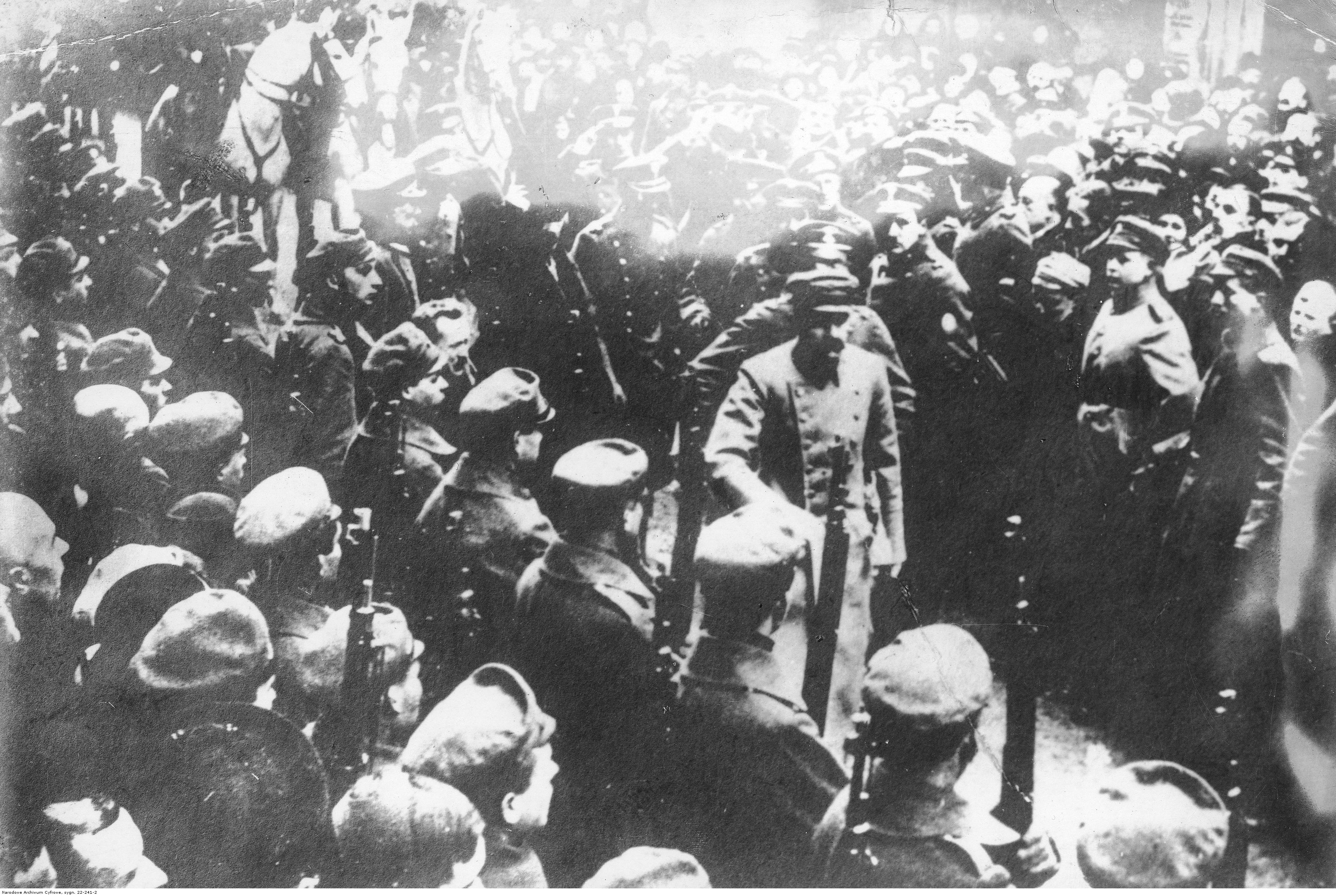
On February 10, 1919, Józef Piłsudski opened the Legislative Sejm in Warsaw. The occasion was more than the return of a familiar institution. Representatives of a country partitioned between three empires were assembling to decide how its citizens would govern themselves. Yet neither the frontiers of that country nor the meaning of its citizenship had been settled. Independence had arrived before agreement about what to do with it.1
For a Polish reader, the dates that followed hardly require introduction: September 1939, August 1944, December 1970, August 1980, June 1989. What deserves reconsideration is the relationship between them. Poland’s modern history cannot be understood only as a succession of betrayals from abroad and recoveries at home. Foreign domination repeatedly narrowed the choices available, sometimes catastrophically. Polish people nevertheless made consequential choices within those constraints, including choices that expanded freedom and others that denied it to their neighbours.
The enduring question is therefore demanding: what does independence mean when a state exists, but its citizens cannot freely determine how power is exercised? Since 1918, Poland has answered through constitutions, wars, migration, industrial labour, religious practice and cultural argument. Those answers have repeatedly changed Europe.
Making a state from three imperial inheritances
November 11, 1918, marks a national restoration, but it compresses a much longer process into one anniversary. Russia’s revolution, Austria-Hungary’s collapse and Germany’s defeat dismantled the combination of powers that had prevented sovereignty. Polish military organizations, local councils, political parties and diplomatic campaigns helped turn that opening into a state. Piłsudski’s return to Warsaw mattered, as did Roman Dmowski and Ignacy Jan Paderewski’s work abroad, peasant mobilization and socialist organizing. No single political tradition could reasonably claim sole authorship.2
The 123 years since the final partition had not been an uninterrupted political vacuum. They included the Duchy of Warsaw, Congress Poland and varying degrees of autonomy, alongside repression and failed uprisings. What returned in 1918 was sovereignty across lands that imperial governments had developed differently. Administrative habits, legal systems, currencies and railway connections followed the old divisions. A border could disappear on a diplomatic document while remaining an obstacle to moving grain, collecting taxes or recognizing a professional qualification.3
War damage made integration harder. Officials needed functioning schools and courts; families needed food, shelter and work. The new republic had to build authority while negotiating who possessed it. Research on interwar markets suggests that overcoming partition barriers was considerably more successful than the familiar picture of permanent fragmentation implies. The achievement was practical: a national economy gradually became something people could experience through transactions and journeys, rather than merely salute.4
Political inclusion also began with an important advance. The electoral decree of November 28, 1918, recognized women’s right to vote and stand for election. Women had organized for that outcome; it was not simply a reward bestowed by grateful male leaders. The first elections brought women into the Sejm, although formal equality left many inequalities in employment and family life intact. Independence opened an argument about citizenship that could not be confined to men in uniform.5
The March Constitution of 1921 grounded authority in the nation and established a parliamentary republic. Its significance lay partly in making disagreement legitimate: peasants, workers, religious communities and competing parties could seek representation through institutions of their own. But building a common political language was difficult after imperial rule and war. The tension between a strong executive and parliamentary accountability was present from the beginning. Later authoritarianism was a choice made within that tension, rather than the unavoidable consequence of Polish political character.6
Winning frontiers and dividing other homelands
Versailles recognized Poland’s place in the international settlement and provided access to the Baltic, but did not finish drawing the country. Uprisings, plebiscites and armed conflicts shaped its western and southern boundaries. In the east, Polish, Ukrainian, Lithuanian and Bolshevik projects overlapped. The same town could belong to different national histories without its inhabitants agreeing on a single future. Self-determination was an appealing principle with no impartial mechanism for resolving every competing claim.7
The Polish–Soviet War became a struggle over both survival and the political organization of the region. Piłsudski’s alliance with Symon Petliura in 1920 accompanied an offensive towards Kyiv; the subsequent Soviet advance threatened Warsaw. The Polish victory in August preserved the republic and frustrated Bolshevik ambitions to carry revolution westwards. It was a military and political achievement, not evidence that the subsequent fate of Europe had become inevitable.8
The Treaty of Riga, signed on March 18, 1921, ended the war but abandoned the prospect of an independent Ukrainian partner within Piłsudski’s projected regional arrangement. Ukrainian and Belarusian lands were divided, while substantial Polish communities remained east of the frontier. Minorities received treaty guarantees that governments did not consistently honour. A settlement could protect Poland’s existence while leaving other peoples without the sovereignty they sought. That tension belongs inside the story of Polish independence.8
The dispute over Wilno, today Vilnius, similarly poisoned relations with Lithuania. Polish attachment to the city did not extinguish Lithuanian claims to it as a historic capital. These conflicts obstructed cooperation among states facing larger neighbours. They also reveal a recurring difficulty: a nation’s justified determination to escape subordination does not automatically produce generosity towards someone else’s claim to decide their future.9
Citizens of one republic with unequal chances
The Second Republic was considerably more diverse than the Poland created after 1945. Ukrainians, Jews, Belarusians and Germans lived alongside the Polish majority, with identities further complicated by religion, language and locality. Categories in censuses were political instruments as well as descriptions. Being a Polish citizen did not necessarily mean speaking Polish at home, being Roman Catholic or accepting the majority’s understanding of national history.10
For Jewish citizens, independence brought political participation alongside insecurity. Bundists, Zionists, religious parties and advocates of assimilation offered different futures. Yiddish newspapers, Hebrew education, Polish-language literature, theatre and cinema made Jewish society an active participant in the country’s modernity. POLIN’s account of the interwar years rightly places flourishing cultural life beside discrimination. The Jewish street was part of Poland, not a separate corridor leading inevitably towards the Holocaust.11
Constitutional guarantees did not prevent economic boycotts, antisemitic violence or exclusion within universities. Ukrainian and Belarusian communities encountered restrictions on education and efforts to impose Polish national culture. The punitive campaign against Ukrainian communities in 1930 intensified grievances; radical Ukrainian nationalists also used political violence. These developments require attention to unequal state power and particular perpetrators, rather than a comforting assumption that everyone’s actions merely cancelled everyone else’s.1012
The colonial question therefore needs care. Partition subjected Polish lands to imperial domination, but Poland’s situation was not identical to that of an overseas colony. Moreover, Polish landholding and state policies could be experienced as domination by Ukrainians and Belarusians. The interwar Maritime and Colonial League even promoted overseas colonial ambitions, although no Polish colonial empire resulted. Having suffered imperial rule did not place Polish society outside the hierarchies and temptations of the imperial age.13
Building modern Poland while narrowing its democracy
Economic sovereignty required more than flags above government buildings. Władysław Grabski’s stabilization and the introduction of the złoty in 1924 addressed monetary disorder. Gdynia offered a port under Polish sovereignty beside the contested arrangements surrounding the Free City of Gdańsk. The Central Industrial Region, advanced under Eugeniusz Kwiatkowski during the later 1930s, connected employment and regional development with defence production. Factories and transport links were instruments for making independence materially sustainable.414
Such achievements coexisted with rural poverty, insecure work and the devastation of the Great Depression. New industry could not quickly absorb the countryside’s surplus labour. The republic was modernizing, but unevenly: the possibilities visible from an expanding port were different from those available on an overcrowded smallholding. Pride in Gdynia need not require imagining that everyone had obtained a share in its promise.14
Cultural life was equally restless. Skamander’s poets, popular entertainment and the experiments associated with Bruno Schulz and Witold Gombrowicz challenged the expectation that literature must always perform solemn national service. Gombrowicz’s Ferdydurke, published in 1937, mocked the forms through which people disciplined one another into approved identities. A sovereign culture could question its own pretensions. The freedom to be irreverent was also one of independence’s possibilities.1516
Political freedom moved in the opposite direction. President Gabriel Narutowicz’s assassination in December 1922 exposed the violence surrounding disputes over who could legitimately represent the nation. Piłsudski’s May Coup in 1926 overthrew parliamentary government in the name of political renewal. Sanacja increasingly constrained opposition; the April Constitution of 1935 concentrated presidential authority. Poland remained independent while its citizens’ ability to hold rulers accountable contracted. Sovereignty and democracy had already ceased to be interchangeable terms.17
Diplomacy supplied no reliable escape from insecurity. Non-aggression agreements with the Soviet Union in 1932 and Germany in 1934 sought room for manoeuvre between dangerous neighbours. Poland also exploited Czechoslovakia’s vulnerability to seize Zaolzie in 1938. That decision damaged regional cooperation without making Warsaw responsible for the aggression Germany subsequently launched against it. Recognizing a serious Polish failure strengthens historical judgement; it does not transfer the invader’s responsibility to the invaded.718
The approaching catastrophe was therefore neither a punishment for national weakness nor a drama whose outcome the participants could read in advance. Poland had limited resources, imperfect alliances and leaders who misjudged important risks. Germany and the Soviet Union nevertheless chose aggression for their own purposes. A history attentive to Polish mistakes must preserve the distinction between explaining vulnerability and explaining responsibility. Otherwise, the language of realism becomes another way of treating smaller states as objects whose consent need never be sought.19
September 1939 and the destruction of public life
Germany invaded on September 1, 1939. The Soviet Union attacked from the east on September 17, implementing the division of spheres agreed secretly with Nazi Germany. Britain and France declared war on Germany but did not provide the effective military relief Polish leaders had expected. Defeat destroyed control of the homeland, although the government continued abroad and Polish armed resistance did not end with the September campaign.19
German occupation brought annexation in some regions and colonial exploitation throughout the occupied country. The occupiers targeted elites, closed institutions, expelled inhabitants and used forced labour and mass terror. Their purpose extended beyond defeating an army: Polish society was to be deprived of the leadership and cultural resources through which it could sustain an independent future. The murder of teachers, clergy and professionals belonged to that project.20
Soviet occupation imposed annexation, arrests, deportations and attacks on independent political and social organizations. Some inhabitants initially welcomed the destruction of the old Polish order; their responses reflected local grievances and hopes as well as ideology. Soviet repression soon reached across communities. The Katyń crime of spring 1940 encompassed the execution of nearly 22,000 Polish citizens at several sites, including officers, police and prisoners. The subsequent official lie prolonged the violence within family life and public memory.21
Both occupiers shattered society, but their institutions, aims and changing policies require separate explanation. Germany’s attack on the Soviet Union in June 1941 brought the formerly Soviet-occupied eastern territories under German control. People who had already experienced dispossession now faced a new occupier and, for Jewish communities, an escalating programme of annihilation. A chronology of changing regimes cannot convey the experience adequately unless it also follows what each change meant for the people subjected to it.1922
The Holocaust and the responsibilities of remembrance
Approximately three million Polish Jews were murdered in the Holocaust. They were citizens of the country whose loss was also the destruction of families, religious worlds, languages and institutions built over centuries. Germany established killing centres in occupied Poland and deported Jews there from across Europe. Auschwitz-Birkenau, Treblinka, Bełżec, Sobibór and Chełmno belong to the history of German-organized genocide; geographical location does not make them Polish institutions.22
Non-Jewish Polish civilians also suffered mass killing, imprisonment, expulsions and forced labour. Overall wartime losses among Poland’s prewar citizens are generally estimated at roughly 5.5–6 million, including the Jewish victims. The categories and methods behind such totals matter: civilian deaths, military losses and victims of different perpetrators cannot simply be added from incompatible estimates. The scale is extraordinary without pretending that every individual fate can be reconstructed or every demographic uncertainty resolved.23
The underground state maintained civilian institutions, clandestine education and an army linked to the government-in-exile. Żegota and other rescuers assisted Jews under the threat of German punishment, including death. Jewish resistance included armed struggle, mutual aid and documentation. Emanuel Ringelblum’s Oneg Shabbat archive preserved evidence of life and destruction in the Warsaw ghetto. Recording what the occupier intended to erase was itself an assertion of human and historical agency.2425
Rescue does not erase denunciation, blackmail or murder by other Poles. In Jedwabne on July 10, 1941, local Polish perpetrators participated in the massacre of their Jewish neighbours under German occupation. The particular role of German instigation and supervision must be investigated without making local responsibility disappear. A truthful national history can honour the courage of rescuers and acknowledge the agency of perpetrators. Neither group can be used to silence the history of the other.26
Nor should the Warsaw Ghetto Uprising of 1943 and the Warsaw Uprising of 1944 be folded into one commemorative event. The first confronted the destruction of the ghetto’s remaining Jews; the second sought to liberate the capital and establish legitimate Polish authority before Soviet domination became irreversible. Their histories intersect, but their immediate circumstances and objectives differed. Preserving that distinction gives both uprisings their proper human and political meaning.2728
For civilians, occupation also threatened the ordinary transmission of knowledge. Clandestine teaching preserved secondary and higher education despite German restrictions and danger. The practical work of finding teachers, rooms and materials belongs beside armed resistance: it defended the possibility of a society after occupation. Within the ghettos, teaching, cultural activity and mutual aid likewise affirmed lives the German authorities intended to destroy. These actions did not make suffering redemptive. They show people continuing to make choices within conditions deliberately constructed to deprive them of choice.29
Fighting for victory without securing freedom
The Home Army’s uprising began on August 1, 1944, and lasted until October 2. German forces massacred civilians and devastated Warsaw. Soviet forces did not provide the intervention needed to save the uprising; the extent of operational constraints and Stalin’s calculations remains a subject of historical analysis. What is clear is that the destruction of the independent underground served Soviet political interests. German responsibility for the killing and demolition remains equally clear.28
Beyond Poland, armed forces fought in the Battle of Britain, at Monte Cassino and elsewhere across the Allied campaigns. Polish cryptanalysts’ prewar work on Enigma also contributed to Allied intelligence. Soldiers who had escaped Soviet imprisonment could reach Italy through Anders’ army, while other Polish formations advanced westwards alongside the Red Army. Those different routes reflected coercion, opportunity and the struggle to survive; they cannot all be reduced to retrospective party labels.3031
The eastern borderlands also witnessed the mass murder of Polish civilians by Ukrainian nationalist forces, especially in Volhynia in 1943, alongside retaliatory Polish violence against Ukrainian civilians. Recognizing the unequal scale and organized character of particular campaigns does not require treating every Ukrainian as a perpetrator or every Polish action as defensive. These losses remain part of family memory and a difficult obligation in Polish–Ukrainian relations.32
A country moved west and remade by force
The postwar settlement shifted Poland westwards. The Soviet Union retained most of the eastern territories annexed in 1939; Poland received former German lands extending towards the Oder and Lusatian Neisse. Lwów and Wilno became losses within Polish memory, while Wrocław, Szczecin and other cities acquired new populations. Decisions by the major Allied powers transformed the relationship between territory, belonging and home.34
Germans fled or were expelled; Poles were displaced from territories incorporated into the Soviet republics; Ukrainians and Belarusians were also transferred across new frontiers. Calling all such movements repatriation concealed the fact that many people were leaving the only home they had known. New inhabitants rebuilt lives amid the possessions and buildings of other displaced families. Acquiring a house did not automatically provide a sense of permanence.34
In 1947, Operation Vistula forcibly dispersed around 140,000 Ukrainians, Lemkos and others from southeastern Poland into northern and western territories. Suppressing the Ukrainian underground did not justify collective punishment based on community identity. Meanwhile, Jewish survivors faced difficulties recovering homes and property, as well as renewed violence. The Kielce pogrom of July 4, 1946, demonstrated that surviving German genocide did not guarantee safety after liberation.3536
Poland’s increased ethnic homogeneity was therefore an outcome of genocide, frontier changes and coercive population movements, not the uncomplicated fulfilment of an ancient national design. The rebuilt Old Town in Warsaw offers a different kind of continuity: a deliberate recovery of an urban inheritance after destruction. Architects, conservators and ordinary workers made reconstruction a social achievement. Its meaning exceeded the communist authorities’ desire to claim the rebuilt capital as proof of their legitimacy.37
Communist modernization under Soviet supremacy
The Soviet-backed authorities consolidated power through intimidation, repression and manipulated votes, including the referendum of 1946 and election of 1947. Independent parties were destroyed or absorbed, and the Polish United Workers’ Party emerged in 1948. The state retained international legal personality, but the political system and security relationship severely restricted sovereign choice. Poland was not incorporated into the USSR; it became a subordinate state within a Soviet-dominated order.33
The Warsaw Pact, established in 1955, formalized that military structure. It did not create the domination already imposed during and after the war. Nor did Soviet supremacy absolve Polish officials of responsibility for their decisions. Polish forces participated in the invasion of Czechoslovakia in 1968. A country subjected to limits on its own independence could also help enforce those limits on a neighbour.3839
Communist rule nevertheless transformed social opportunities. Land reform dismantled large estates; industrialization moved people into towns; expanded education widened access beyond established elites. Families could associate the period with upward mobility, a first university degree or an apartment, while remembering censorship and shortages. Such experiences were real without proving that dictatorship was necessary to obtain them. Poland’s modernization belonged to the labour of its people as well as to state planning.4041
Women entered education and paid work in larger numbers, but official equality coexisted with occupational segregation, unequal authority and responsibility for domestic labour. The worker and the self-sacrificing mother were often expected to inhabit the same exhausted person. Private farming also survived far more extensively than Soviet models envisaged. Polish society negotiated, resisted and adapted to the system; it was never simply a blank surface upon which Moscow wrote instructions.4240
Daily adaptation could produce ambiguous loyalties. Someone might value a state education, dislike the party, attend Mass and participate in official workplace rituals without experiencing these positions as a coherent political programme. Remembering only committed dissidents and committed communists leaves most of society out of view. It also obscures the labour through which families sustained themselves amid scarcity. The networks used to secure food, childcare or repairs could accommodate the system, while teaching habits of cooperation that later helped people organize independently.43
Culture and institutions beyond the party
The Catholic Church preserved an institutional space the party could constrain but never completely absorb. Cardinal Stefan Wyszyński’s internment and the conflicts surrounding religious education demonstrated the stakes. Clergy and believers sustained networks of trust and public ritual outside official ideology, although church leaders also negotiated compromises. Catholic identity could protect social autonomy without encompassing everyone’s understanding of Polishness.44
The protests in Poznań in June 1956 and the subsequent political thaw brought limits to Stalinism, not a democratic settlement. Władysław Gomułka’s return created hopes that soon encountered renewed censorship and political control. In March 1968, student protests met repression, while the authorities mobilized antisemitism under the language of anti-Zionism. Thousands of Polish Jews were driven into emigration, often stripped of citizenship. The state again narrowed the nation by excluding people who belonged to it.4546
Culture made conformity harder to complete. Cinema, theatre, poetry and jazz offered languages that escaped the exhausted formulas of official politics. Andrzej Wajda’s films complicated heroic memory; writers could question the moral accommodations through which people survived. Publication, performance and interpretation became negotiations over what might be said. Not every cultural achievement was opposition, but the existence of an audience capable of reading between the lines frustrated any ambition to monopolize meaning.47
The killing of protesting workers on the Baltic coast in December 1970 exposed the violence beneath claims to working-class rule. Edward Gierek’s subsequent development programme relied partly on Western credit, linking socialist modernization to international finance. When debt and shortages undermined that promise, renewed price rises provoked protests in 1976. The Workers’ Defence Committee connected assistance for persecuted workers with intellectual dissent. Opposition became stronger when it learned to cross the social divisions the authorities had exploited.4849
Emigration and exile also remained part of the national conversation. Czesław Miłosz’s departure and the censorship surrounding his work exposed the difficulty of controlling a culture whose readers and writers extended beyond the state’s frontiers. Distance could protect freedom of expression while separating authors from the people and places that shaped their writing. Cultural sovereignty thus depended on more than institutions inside Poland. A government might control a publishing licence, but it could not definitively decide where Polish literature belonged or who was entitled to read it.50
Solidarity made the language of dignity collective
Karol Wojtyła’s election as Pope John Paul II in 1978 and his return to Poland in 1979 helped demonstrate a public community larger than the party’s institutions. Religion mattered deeply to the movement that followed, but Solidarity cannot be explained as a papal achievement alone. Workplace organization, earlier protests, underground publications and the practical courage of people protecting one another had already created the means to act.5152
In August 1980, the dismissal of Anna Walentynowicz helped trigger the Gdańsk shipyard strike. Women including Walentynowicz and Alina Pienkowska played crucial roles in sustaining solidarity with other workplaces when a local settlement threatened to end the action. Lech Wałęsa’s leadership mattered, but the familiar image of one man at a gate cannot contain the movement’s creation. Its strength lay in refusing to abandon people with less bargaining power.52
The twenty-one demands joined independent trade unions and freedom of expression to wages, welfare and everyday security. Solidarity became a movement of roughly ten million members, bringing together people whose beliefs and long-term ambitions differed. It claimed that workers could speak for themselves and that social life required institutions beyond party permission. The challenge was devastating precisely because it arose within the society communism claimed to represent.5354
On December 13, 1981, General Wojciech Jaruzelski imposed martial law. Internment, censorship and armed repression broke the movement’s legal structures but not its networks. His later claim that this prevented an otherwise inevitable Soviet invasion remains contested; archival evidence does not establish inevitability. Underground publishing, assistance to prisoners’ families and continued organizing preserved an alternative public life. The state could take control of streets more readily than it could restore belief in its authority.55
The movement’s welfare demands deserve particular attention in retrospect. People were not merely asking permission to become participants in a future market economy. They wanted secure livelihoods, decent provision for families and meaningful control over workplaces. Later disagreements about the transformation partly arose because those aspirations did not all point towards the same economic settlement. Remembering this breadth restores the choices that existed within Solidarity itself. Democracy emerged from a diverse social movement; no subsequent party could inherit its entire meaning without remainder.53
The negotiated breach of 1989
The elections beginning on June 4 were only partly free for the Sejm: the governing coalition reserved 299 of its 460 seats. The Senate contest was fully competitive. Across the two rounds, Solidarity’s Citizens’ Committee won all 161 openly contested Sejm seats and 99 of 100 Senate seats. Those results destroyed the authorities’ claim to popular legitimacy and opened possibilities the negotiated framework had been designed to contain.57
Tadeusz Mazowiecki became prime minister in August. The transition continued through institutional changes, competitive elections and arguments over the former regime’s personnel and crimes. The Warsaw Pact dissolved in 1991, and the withdrawal of the former Soviet garrison was completed in 1993. Sovereignty returned through a sequence of changes, rather than one moment when an entirely finished democracy stepped into view.5859
Disputes over the settlement remain part of Polish politics. For some, negotiation prevented bloodshed and made peaceful change possible; for others, it protected entrenched interests and left accountability unfinished. These interpretations deserve examination against what participants could know at the time. The outcome also helped alter Europe: Polish workers, voters and negotiators had weakened the Soviet order before the Berlin Wall supplied its most internationally familiar image of collapse.56
Markets and Europe brought opportunity with a price
The economic reforms introduced under Leszek Balcerowicz in 1990 sought to stop inflation, end shortages and replace the command economy with market institutions. They also exposed enterprises and households to a severe adjustment. Employment disappeared, established skills lost value and communities organized around state workplaces faced uncertain futures. For those affected, transformation was measured in a closed factory or an unaffordable bill before it appeared as a favourable national indicator.60
Poland subsequently achieved sustained growth and a substantial narrowing of its income gap with Western Europe. That success deserves recognition without turning it into a retrospective argument that every policy was unavoidable. Research also disputes the comforting claim that growth left inequality essentially unchanged: tax-based estimates reveal gains at the top that household surveys miss. Aggregate prosperity and uneven security can coexist. Neither cancels the other’s political consequences.6162
NATO membership on March 12, 1999, and EU accession on May 1, 2004, changed the institutional setting of independence. Polish governments actively sought these memberships; Poland was not simply transferred from one patron to another. NATO offered collective defence, while EU membership provided markets, funding, mobility and participation in common decisions. Both created obligations. Their essential difference from Soviet domination lay in consent, political representation and the capacity to contest policy within treaty institutions.5963
Migration made those changes intimate. Working abroad could finance housing, education and new possibilities, while separating parents, children and partners. Open borders expanded individual choice but revealed differences in wages and opportunity. Poland’s relationship with Europe became something lived through workplaces and family arrangements, alongside disputes in Brussels. The national question increasingly concerned how to exercise influence within interdependence, rather than how to seal the country away from it.64
The social consequences also varied by place. Communities dependent on one employer faced a different transition from metropolitan areas attracting investment, universities and new services. A national growth rate could not describe the loss of a local institution around which daily life had been organized. Economic historians disagree about how best to measure the distribution of gains, but that disagreement strengthens the case for examining households and regions separately. It helps explain why pride in Poland’s development has coexisted with demands for more secure work and stronger public provision.6265
Democracy and belonging remain unfinished arguments
The constitution adopted in 1997 placed rights, representative institutions and limits on government within the framework of the Third Republic. Yet elections alone did not settle disputes over judicial independence, public broadcasting or the relationship between majority rule and constitutional restraint. Changes introduced during Law and Justice governments after 2015 provoked domestic opposition and European proceedings. These were arguments about who could control the state, not merely disagreements over Poland’s reputation abroad.6667
The parliamentary election of October 2023 brought turnout above 74 per cent and eventually a coalition government led by Donald Tusk. International observers found a competitive contest while criticizing the governing party’s advantages in state resources and public media. Karol Nawrocki, supported by Law and Justice, won the presidency in 2025. By November 2026, divided authority and continuing disputes over courts showed that democratic repair was itself politically and legally contested.686970
Social change also challenges inherited equations between Catholicism and national belonging. Recent research records a substantial generational difference in religious identification. Disputes over abortion, LGBT equality and the Church’s public authority concern who may decide how others live. The institution that defended autonomy against communist rule can itself face demands for accountability. Its historic contribution does not settle every present claim about citizenship or personal freedom.7172
Contemporary culture continues this argument through other means. Olga Tokarczuk’s fiction and her Nobel lecture consider movement across boundaries, neglected lives and the responsibilities of telling stories. Such work belongs to a Polish tradition of questioning inherited forms, even when that questioning provokes anger at home. International recognition does not require a culture to become less Polish. It can reveal how experiences rooted in particular places illuminate questions shared elsewhere: whose suffering is visible, whose history is remembered and who gets to narrate a common world.73
Russia’s full-scale invasion of Ukraine in 2022 made the security question immediate again. Poland became a crucial place of refuge and support; UNHCR recorded nearly 978,000 refugees from Ukraine in February 2026. Their lives and work form part of contemporary Polish society. Solidarity has also encountered fatigue, competition and political hostility. Historical empathy does not automatically resolve arguments over housing, welfare or how newcomers are treated.74
The humanitarian crisis at the Belarusian border exposes another test. Authorities cite the deliberate exploitation of migration by Belarus and Russia; rights organizations document pushbacks and restrictions on access to asylum. Defending a frontier and protecting people from unlawful treatment are simultaneous responsibilities. A history of displacement gives these arguments particular resonance, but supplies no exemption from examining what the Polish state does in the present.72
A more diverse present also changes how the past can be approached. Restoring Jewish histories to museums and local memory, recognizing Lemko and Ukrainian experiences, and acknowledging the German histories of western cities need not weaken attachment to Poland. They make that attachment more historically informed. POLIN’s presentation of a millennium of Jewish life, rather than only its destruction, offers one example. National continuity can include the recovery of people and stories that previous definitions of the nation pushed to the margins.75
Independence today cannot mean freedom from every external constraint. It means possessing institutions through which citizens can choose commitments, challenge rulers and argue over their common future. Poland’s experience since 1918 shows how much that capacity can cost to recover, and how easily sovereignty can be invoked to restrict it. The achievement is larger than survival between powerful neighbours: Polish people helped remake the European order. Whether that achievement serves everyone who belongs to Poland remains a question its citizens must be free to answer.